For generations, exploring the universe or understanding advanced quantum physics meant investing in expensive textbooks, securing lab time, or lugging a 50-pound telescope into the freezing night air. Today, our mobile devices have mutated into sophisticated science instruments. Armed with precise GPS chips, advanced gyroscopes, and augmented reality (AR) engines, the smartphone in your pocket is fully capable of mapping the night sky or simulating complex atomic reactions in real time.
However, navigating the app stores for high-quality STEM tools presents its own set of challenges. The market is saturated with glitchy star maps that lag as you rotate your phone, and "educational" software that amounts to little more than a digitized textbook wrapped in annoying pop-up ads. When testing software for this roundup, specific benchmarks were established: intuitive user interfaces, zero tolerance for intrusive monetization, deep databases, and robust offline capabilities—crucial for remote stargazing where cellular service drops to zero.
After putting dozens of tools through their paces, several standout applications consistently delivered flawless performance, proving themselves invaluable for backyard astronomers and science enthusiasts alike.
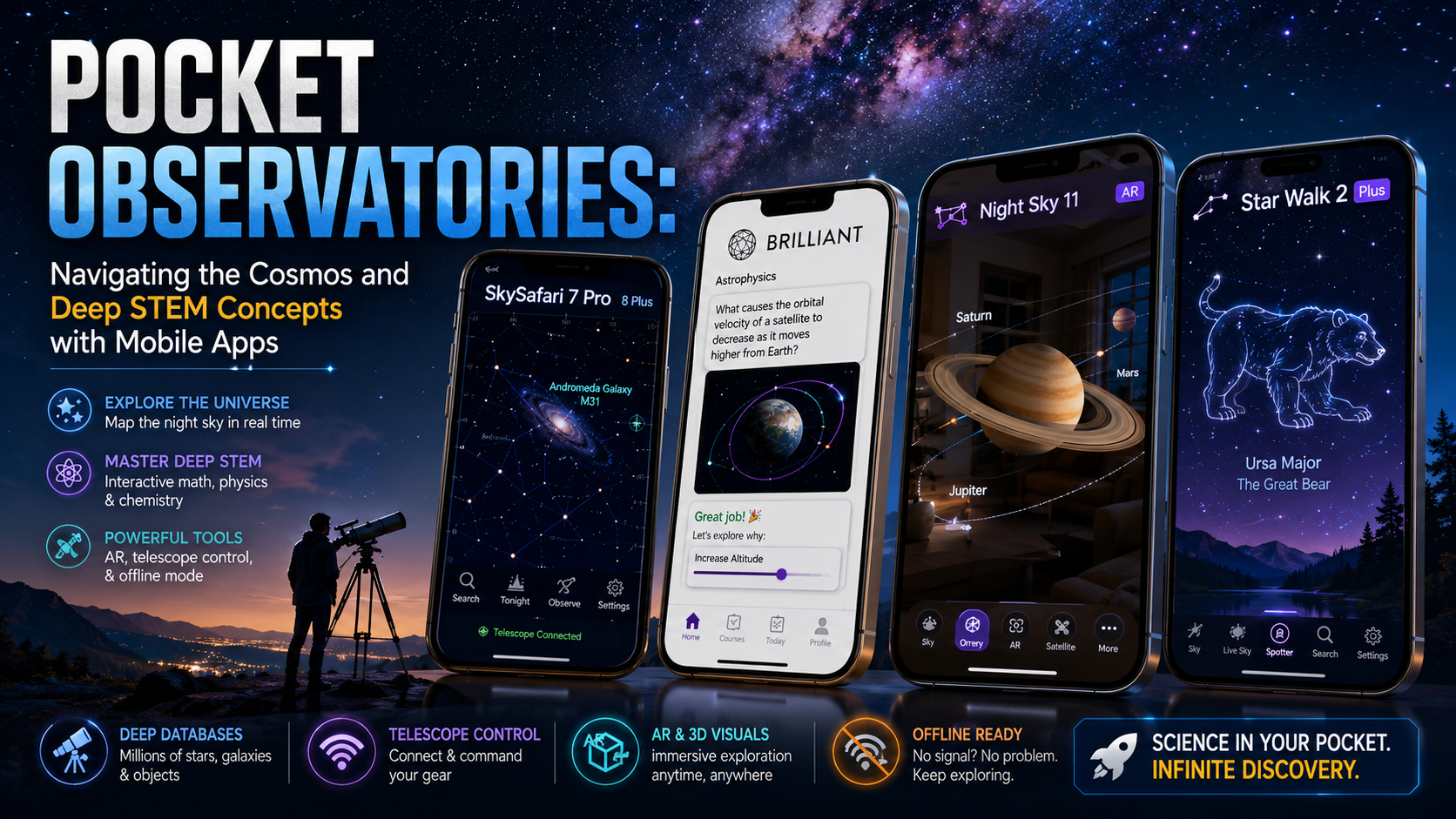
When testing SkySafari on a completely clear, moonless night away from city light pollution, its massive scope becomes immediately obvious. This isn't just an app for identifying the Big Dipper; it is a professional-grade planetarium crammed into a mobile interface.
The standout, uncompromised feature here is its legendary database and telescope control. SkySafari 7 Pro contains over 100 million stars, 3 million galaxies down to the 18th magnitude, and 750,000 solar system objects. When pinpointing an obscure deep-sky object, like the Needle Galaxy, the app's precision is breathtaking. Furthermore, its ability to connect via Wi-Fi or Bluetooth to computerized telescope mounts allows users to tap an object on their screen and watch their physical telescope autonomously slew and lock onto the target. For those seeking the absolute latest in observing tools, the newly released SkySafari 8 Plus iteration elevates this experience further by adding advanced event-finding tools and plate solving, which instantly matches astrophotography images directly to the live night sky.
Unparalleled Database Depth: Houses virtually every celestial object an amateur or advanced astronomer could ever dream of targeting.
Flawless Telescope Integration: Seamlessly commands computerized equatorial and alt-azimuth mounts.
Advanced Orbit Simulations: Allows users to travel up to 10,000 years into the past or future to visualize eclipses and planetary alignments.
Heavy Storage Footprint: The pro databases require gigabytes of local storage space.
Steep Learning Curve: The dense array of menus, coordinates, and observing lists can overwhelm casual users.
Premium Pricing: At roughly $21.99+ depending on the exact tier, it represents a serious investment compared to basic alternatives.
For those looking to understand the underlying physics, math, and chemistry that govern the cosmos, standard video lectures often fail. Staring at a whiteboard presentation doesn't translate to real intuition. That is the exact friction point Brilliant eliminates.
Brilliant bypasses passive consumption entirely, favoring interactive, gamified problem-solving. When testing their courses on astrophysics and quantum mechanics, the app does not force users to memorize dry equations. Instead, it challenges users with visual puzzles that teach the foundational concepts of orbital mechanics, gravitational pull, and light refraction. The core feature that works beautifully here is the immediate, bite-sized feedback loop. If an engineering or physics puzzle is answered incorrectly, the app doesn't just hand over the solution; it systematically deconstructs the logic behind the concept using interactive sliders and visual animations.
Active Learning Model: Teaches complex STEM and physics concepts through intuitive, hands-on puzzles rather than boring walls of text.
Superb User Interface: Exceptionally clean, highly responsive, and beautifully animated layouts.
Broad STEM Curriculum: Spans everything from foundational pre-algebra to advanced neural networks and astrophysics.
Cost Prohibitive: Requires a steep recurring subscription (roughly $25+/month) to unlock the full library.
Lacks Academic Certifications: Built for personal enrichment and conceptual mastery rather than earning official university credits.
For Apple hardware users, Night Sky 11 represents the absolute pinnacle of what modern augmented reality can achieve on mobile operating systems.
The "Sky Tags" and AR planetary exploration systems are unmatched. When stepping outside and lifting an iPhone to the sky, the app maps out constellations, satellites, and space debris with butter-smooth tracking. What genuinely impresses during live testing is the "Grand Orrery" mode. It projects a highly detailed, interactive 3D model of our entire solar system right into a living room or backyard space. Users can physically walk through planetary orbits, scale up Saturn's ring system, and inspect the structural breakdown of the James Webb Space Telescope with stunning graphical fidelity.
Industry-Leading AR Tracking: Incredibly stable overlay mapping that leverages Apple's metal graphic architecture perfectly.
Immersive Satellite Tracking: Provides real-time passes and customizable push notifications for the International Space Station (ISS) and Starlink trains.
Indoor Accessibility: The robust 3D models allow for highly educational "stargazing" sessions even during stormy weather or heavy light pollution.
Platform Locked: Entirely unavailable for Android users.
Aggressive Subscription Monetization: While a limited version is free, unlocking the full premium feature suite requires a recurring subscription that adds up over time.
If SkySafari is a complex scientific tool and Night Sky is an AR showcase, Star Walk 2 Plus is the definitive introductory gateway for families, casual stargazers, and young students.
Star Walk 2 Plus excels at visual storytelling and immediate identification. The core feature that works flawlessly is the "Spotter" mode. Standing in a dark backyard, pointing a device upward instantly aligns the screen with the exact stars overhead, accompanied by an ethereal, atmospheric soundtrack and gorgeous 3D artwork overlays of classic constellations. The "Plus" edition clears away the disruptive ad structures of the baseline free tier, providing clean, unfiltered access to planetary internal structures, deep-space nebulae, and historical astronomical data with zero friction.
Stunning Visual Aesthetic: The atmospheric audio and hand-drawn historical constellation art make it an absolute joy to use.
Highly Optimized Performance: Runs smoothly on older, less powerful iOS and Android hardware without exhausting the battery.
Excellent Value: The paid "Plus" version or affordable individual modular upgrades provide high-end features without a massive financial commitment.
Lacks Analytical Depth: Serious backyard astronomers will find the databases too shallow for tracking highly obscure deep-sky targets.
Sensitive to Magnetic Interference: The compass calibration can occasionally drift if used near large metal structures or vehicles.

Choosing the absolute best app depends entirely on your specific scientific mission:
For the serious amateur astronomer who owns a telescope, plans dark-sky excursions, or tracks deep galaxies, SkySafari 7 Pro (or 8 Plus) remains the undisputed king of mobile planetariums. Its massive database and robust instrument controls make it irreplaceable.
However, for the curious everyday explorer who wants to walk outside, identify mysterious points of light over the horizon, and easily grasp the physics of our universe, Night Sky 11 (for iOS users) and Star Walk 2 Plus (for cross-platform users) offer the perfect balance of visual awe, accessible price points, and reliable real-world performance.