Learning an instrument or decoding music theory has historically relied on a strict, expensive gatekeeping system. You hired a private tutor, sat through rigid weekly recitations, and puzzled over dry workbook lines trying to figure out how a major third differs from a minor third. For modern learners, mobile apps promise a democratic alternative. Using your device's built-in microphone, advanced real-time pitch detection, and interactive fretboards or keyboards, these apps aim to turn a smartphone or tablet into an on-demand music conservatory.
However, the digital instrument landscape is cluttered with frustratingly poorly engineered software. Many basic applications suffer from erratic microphone latency—telling you that you missed a note when you played it perfectly—or rely on shallow, synthesized track lists that get old after two days. When testing the software for this analysis, we held apps to rigorous real-world standards: acoustic pitch tracking precision, the structural logic of the underlying music theory curriculum, tactile interface responsiveness, and honest monetization frameworks.
After hours of strumming, plucking, and singing into mobile screens, these four outstanding tools proved they can build genuine musical competency from scratch.
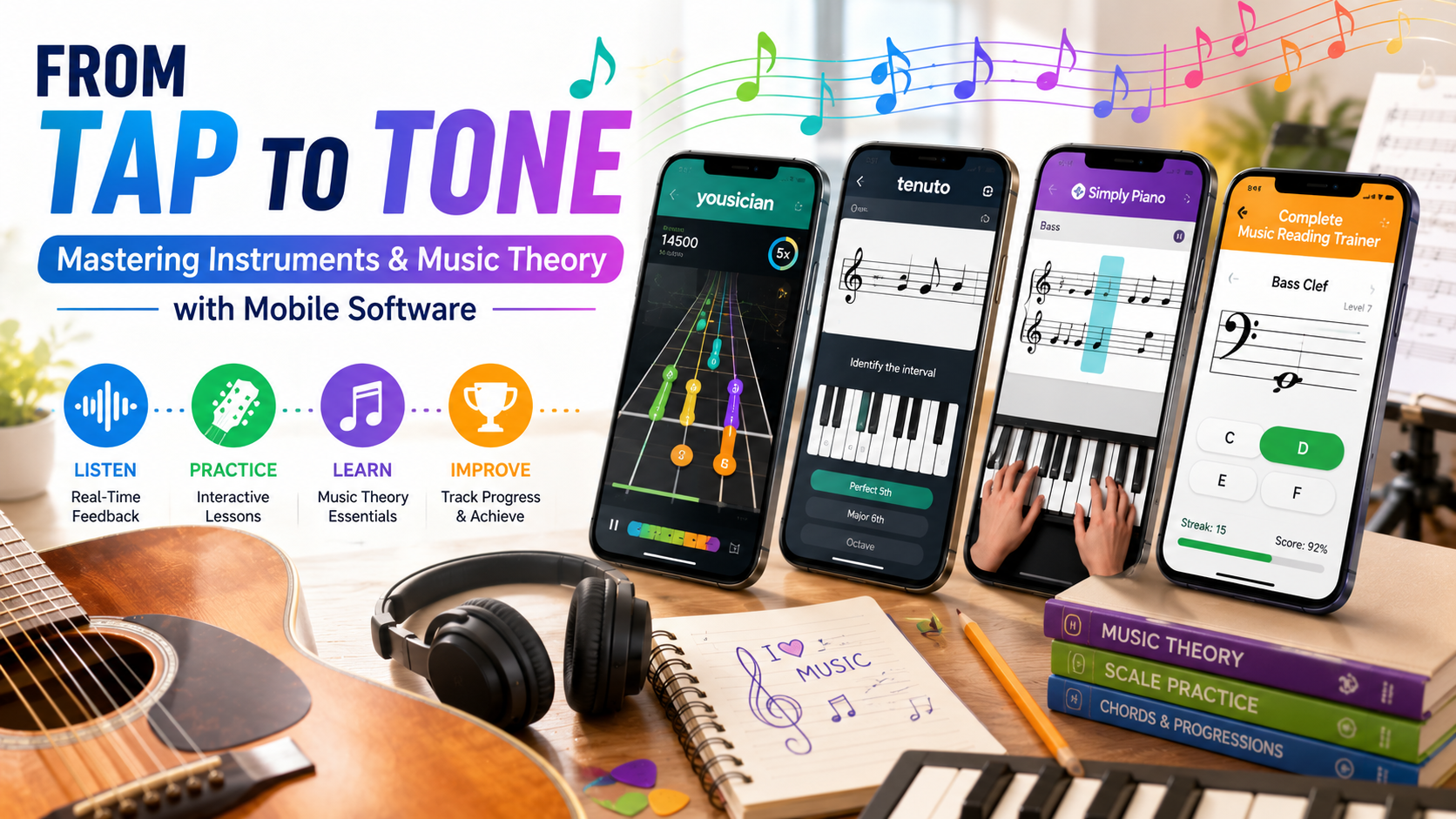
Yousician positions itself as a comprehensive digital music academy, supporting guitar, bass, piano, ukulele, and vocals all within one ecosystem. It adapts the "Guitar Hero" visual language to real physical instruments.
The engine that drives Yousician is its real-time audio recognition software, and it functions shockingly well. When we tested this with an acoustic guitar in a room with standard ambient background noise, the app’s pitch-tracking algorithm rarely lagged. As you play along to a scrolling tablature track on your screen, the app changes color instantly to show your accuracy: green for a perfect hit, red for a complete miss, and yellow for timing errors. Rather than just forcing you through dull scales, it chunks learning into concrete, gamified skill blocks—such as fingerpicking or alternate strumming—interspersed with a licensed catalog of popular songs.
Superb Pitch Recognition: Calibrates fluidly to standard smartphone microphones without requiring expensive external audio interfaces.
Multi-Instrument Versatility: A single ecosystem can guide you from learning basic ukulele chords to advanced bass guitar patterns.
Smart Progress Mapping: Features structured, interactive lesson trees that refuse to let you unlock complex tracks until you prove you can play fundamental tempos.
Heavy Financial Commitment: The "Premium" single-instrument tier costs around $14.99/month, while the comprehensive "Premium+" plan jumps to roughly $29.99/month (or $13.33/month billed annually at $159.99/year).
Tablature Crutch: The game-like scrolling timeline can accidentally train your eyes to read the app's moving bar rather than developing independent sight-reading skills.
For students who want to pull back the curtain on why music works, Tenuto is the definitive pocket companion. Developed by the creators of the highly regarded educational portal MusicTheory.net, it strips away graphics fluff in favor of pure, surgical data entry.
Tenuto is an interactive collection of 24 highly customizable exercises designed to build ear training, fretboard/keyboard recognition, and staff literacy. When we tested its interval identification and chord ear-training blocks, the app proved to be an invaluable utility tool. It sounds a tone (such as a diminished seventh chord), and you have to identify the inversion or the individual scale degrees on an on-screen keyboard or staff. There are no animations, point multipliers, or virtual avatars here—just a pure, highly responsive tool that builds the fundamental neural pathways required for real-time composition and transposition.
Brilliant One-Time Cost: Eschews predatory subscription models entirely for a single, flat $4.99 download fee on the App Store.
Deep Architectural Customization: Allows you to scope exercises to your exact needs (e.g., configuring a fretboard quiz to show only the first five frets of a bass in Drop D tuning).
Comprehensive Ear Training: Trains your brain to quickly recognize complex intervals, chord inversions, and scale qualities entirely by ear.
Platform Locked: Zero support for Android users; it is strictly an iOS and iPadOS exclusive.
Unforgiving Design Aesthetic: The stark, text-heavy interface can look intimidating and dry to younger students or casual hobbyists.
Simply Piano by Simply Ltd. focuses its entire engineering apparatus on a single goal: taking an absolute novice and teaching them to read two-handed sheet music on a keyboard.
What sets Simply Piano apart from simple tutorial videos is its dual track pedagogical structure: "Soloist" (focused on note reading and technical precision) and "Chords" (focused on rhythm and accompaniment). When we put it to the test using a mid-range digital piano, its "Acoustic Listening" engine picked up simultaneous left- and right-hand key strikes without stuttering. The onboarding sequence introduces notation gracefully; you learn one note on the treble staff, play it in three different rhythmic variations, and then immediately integrate it into an arrangement with a professional backing track.
Superb Sheet Music Integration: Transitioning from the app's scrolling bars to reading traditional staves feels completely natural.
Exceptional Asset Quality: The backing tracks are beautifully produced, making early-stage practice sessions feel genuinely musical instead of tedious.
Multi-Profile Friendly: The annual Family Plan options allow multiple users to maintain separate progress states on a single subscription.
Premium Gatekeeping: Outside of a brief 7-day trial, accessing the core material demands a hefty subscription of roughly $119.99 to $149.99 annually.
Acoustic Over-Sensitivity: If you use your device's open microphone rather than a direct MIDI connection, a loudly played note can occasionally bounce off a wall and register as a double strike.
If you find yourself constantly stumbling over ledger lines, struggling with bass clef, or freezing when a piece introduces a new key signature, Complete Music Reading Trainer provides the ultimate focus filter.
Designed like an arcade speed-run, this application is a targeted drill machine for sight-reading sheet music. The core feature that works exceptionally well is its custom drill generator. When we set up a trial run targeting only the bass clef with two sharps in the key signature, the app generated rapid-fire notation cards. You tap the note name or an on-screen keyboard to respond, and the app uses a progressive system to increase the scroll speed as your accuracy ticks up. It acts exactly like a digitizer for physical flashcards, paired with clear analytical feedback that shows you precisely which lines or spaces on the staff cause you to slow down.
Flawless Sight-Reading Speed Drills: Highly effective at eliminating the mental lag time between looking at a note on a page and identifying its name.
Incredible Consumer Value: Free to download and test the initial chapters, with a highly affordable one-time in-app purchase ($4.99–$5.99) to unlock the entire application forever.
Clef Diversity: Includes thorough training modules for Treble, Bass, Alto, and Tenor clefs.
No Instrumental Feedback: It is a standalone tool for note-reading literacy; it does not listen to your physical guitar or piano to verify performance accuracy.
No Lyricism or Artistry: The focus is purely mechanical, meaning it won't teach you subtle phrasing, dynamics, or structural expression.
Your ideal musical companion app hinges heavily on your current skill level and what instrument you want to learn:
For the multi-instrumentalist or beginner guitarist who needs an engaging, gamified interface to stay disciplined, Yousician offers the most complete package. Its pitch detection engine is top-tier, easily justifying its premium subscription costs if you log hours across multiple instruments.
If your goals are strictly centered on mastering the keyboard and learning to read sheet music cleanly, Simply Piano provides a far superior classical foundation and a better overall onboarding structure for the keys.
However, for the serious student or self-starter who already owns an instrument but wants to unlock the actual language of music—mastering sight-reading speeds and deep chord architecture without breaking the bank—the combo of Complete Music Reading Trainer and Tenuto provides an unmatched, highly professional studio toolkit for under ten dollars combined.