Climbing the corporate ladder or pivoting into a new technical field used to require massive sacrifices: pausing your career, taking out student loans, and spending years sitting in a university lecture hall. Today, major professional certificate platforms promise a faster, completely decentralized route to upskilling. Armed with modular video assets, cloud-based programming sandboxes, and official partnerships with tech titans like Google, Meta, and IBM, mobile learning applications aim to convert your daily commute or late-night down hours into CV-building momentum.
However, the rapid growth of the digital credential economy has created significant noise in the market. The app stores are littered with generic platforms that bundle sub-par tutorial videos under the guise of "professional certification," charging steep fees for paper completion slips that hiring managers routinely ignore. When testing platforms for this review, specific real-world benchmarks were strictly enforced: the institutional hiring authority of the certificate, the stability and depth of the mobile learning interface, project-based evaluation metrics, and transparent value-to-cost ratios.
After completing dozens of course blocks, evaluating graded mobile assignments, and testing offline syncing capabilities across major ecosystems, three prominent platforms stood out as genuinely effective tools for career advancement.
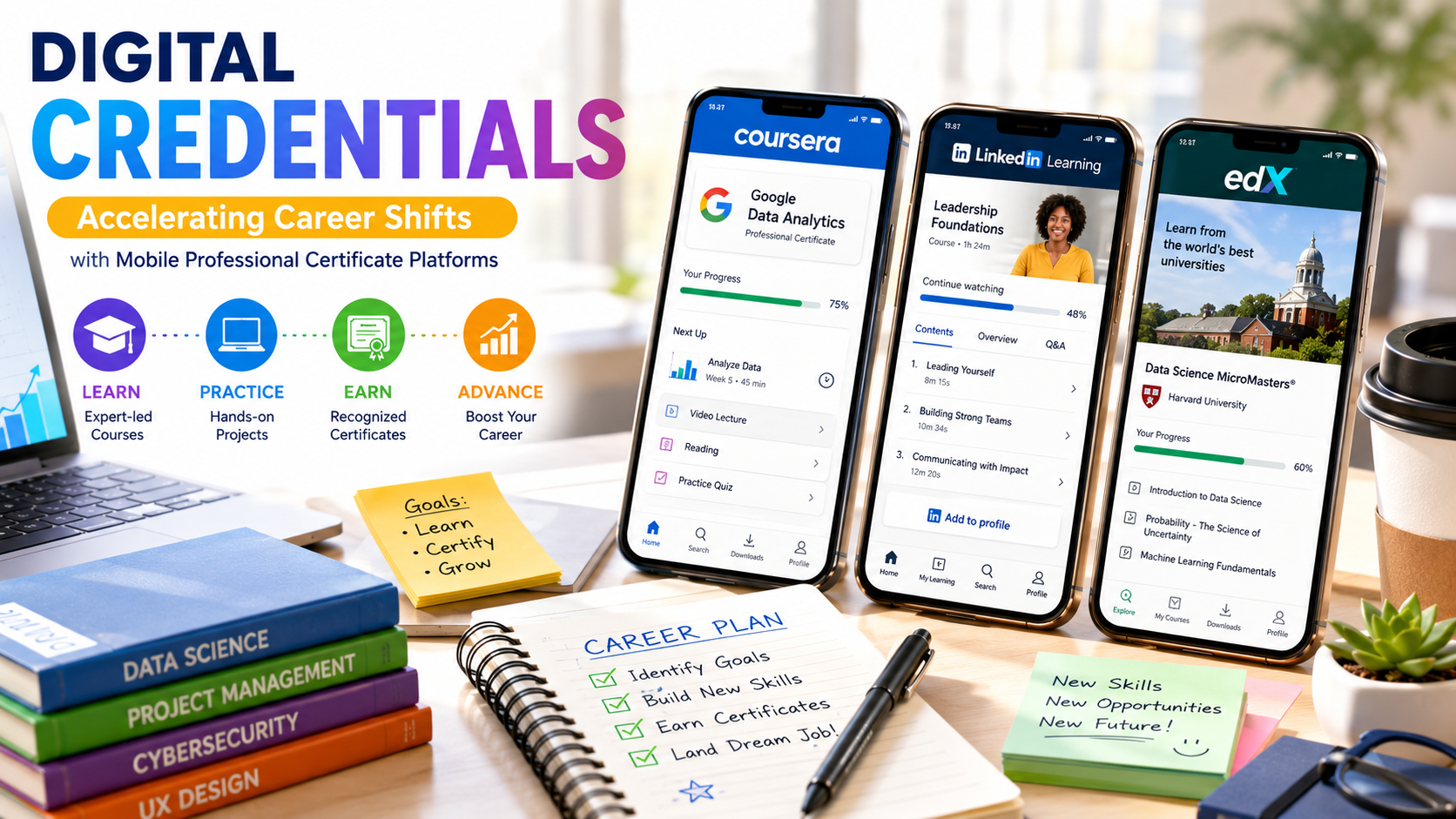
Coursera remains the absolute heavyweight in the professional credential landscape. By partnering with elite global universities (like Stanford and Yale) alongside corporate infrastructure giants (like Google, Meta, and IBM), the platform acts as a bridge between foundational theory and immediate corporate utility.
The core feature that sets Coursera apart on mobile devices is its robust, native handling of comprehensive, multi-course Professional Certificates (such as the Google Data Analytics or Meta Front-End Developer tracks). When we tested these tracks on a mobile screen, the application seamlessly adapted complex course materials. Video segments are paired with perfectly synchronized, interactive reading transcripts directly underneath. Tapping any word in the transcript jumps the video explicitly to that moment. Furthermore, multiple-choice quizzes and peer-review rubrics load rapidly within the interface, meaning you can complete weekly conceptual checks while away from a computer.
High CV Authority: Certificates are issued by universally recognized tech companies and elite academic institutions, holding genuine weight on resumes and LinkedIn profiles.
Flawless Mobile Architecture: The interface is built for deep study, featuring offline video downloads, crystal-clear audio tracking, and background playback options.
Comprehensive Learning Paths: Moves past standalone courses, structuring classes into multi-month "Specializations" designed to take beginners to entry-level job readiness.
Fragmented Pricing Friction: Individual professional certificates cost between $39 to $79 per month depending on how long you take to finish, while the all-access Coursera Plus tier runs a steep $59/month or $399/year.
Mobile Technical Limitations: While quizzes and readings translate beautifully to a phone, complex coding labs or large data-modeling projects still require a desktop browser interface to complete successfully.
Born out of LinkedIn's acquisition of Lynda.com, LinkedIn Learning takes an aggressively practical, skill-focused approach to continuous professional development. Rather than aiming for full academic credit, it emphasizes micro-credentials meant to optimize your immediate job performance and market visibility.
The standout, uncompromised asset here is the automated ecosystem synchronization. The second you finish a certificate path within the mobile app, the platform prompts you with a single-tap button to embed the credential and its associated skills directly into your live LinkedIn profile. When we tested this flow, it proved remarkably frictionless. The app specializes in snackable, highly hyper-focused content blocks—like mastering an advanced Excel function, practicing project management methodologies, or implementing specific leadership strategies. The app's audio-only mode stands out as a highly effective feature, allowing you to turn video lectures into a highly polished, podcast-style learning experience during long drives.
Direct LinkedIn Profile Integration: Instantly signals new competencies to active recruiters looking for specific keywords and skill endorsements.
Premium Career Bundle Incentives: Subscribers to LinkedIn Premium Career ($39.99/month) get complete, unlimited access to the entire 22,000+ course learning catalog at no extra charge.
Exceptional Technical Production: The audio formatting, scripting, and video presentation quality across courses maintain a remarkably high, professional standard.
Shallow Academic Weight: Because individual courses are often brief (1 to 3 hours), completion badges show professional initiative rather than rigorous, board-certified competency.
Standalone Individual Pricing Is High: At $39.99/month (or $239.88 billed annually as roughly $19.99/mo), it represents a notable recurring expenditure if you aren't using the broader LinkedIn premium job-hunting tools.
If Coursera leans heavily toward corporate career training and LinkedIn Learning rules workplace micro-skills, edX is the definitive home for rigorous, graduate-level academic credentials. Founded by Harvard and MIT, the platform specializes in deep-dive theoretical structures and highly structured MicroMasters programs.
The feature that operates flawlessly within the edX app is its clean, zero-cost "Audit" track engine. Unlike competitors that lock course materials behind immediate credit card paywalls, edX allows mobile users to review virtually its entire catalog of high-level courses from elite global universities absolutely free. When we tested their advanced data science and machine learning modules, we were able to read full lecture materials and stream elite faculty videos without inputting financial details. You pay only if you decide you explicitly need a verified, graded certificate of completion at the end of the term.
Unmatched Academic Rigor: Houses credentials and intensive courses from top-tier research institutions like Harvard, Berkeley, and Oxford.
Genuinely Generous Free Audit Tier: Excellent for self-directed learners who care deeply about acquiring hard knowledge rather than collecting paper credentials.
Robust Offline Accessibility: Allows for full video downloads alongside readable text transcripts for uninterrupted learning on flights or in remote areas.
Intimidating Layouts for Casual Users: The curriculum design mirrors university syllabi, featuring rigid academic timelines, heavy reading loads, and complex exam structures that can feel overwhelming on mobile.
Expensive Individual Verification: Buying a verified track for a single course or professional certificate often costs anywhere from $50 to $300+, making a multi-course path highly expensive without a centralized subscription option.

The definitive platform for online professional certificates depends entirely on your immediate career objectives and preferred learning speed:
For professionals looking to completely pivot careers or break into an entry-level tech role (such as IT, project management, or UX design), Coursera is the absolute gold standard. The depth of its multi-month corporate partnerships creates highly recognizable resume credentials that active hiring managers actively look for.
If you are actively job hunting or trying to round out specific micro-skills to secure a promotion within your current corporate field, LinkedIn Learning provides the most agile solution. The direct, single-tap integration into your live professional profile provides immediate visibility advantages that no other platform can replicate.
Finally, for the academic purist or self-taught researcher who wants to learn advanced engineering, business strategy, or data architectures directly from Ivy League faculty without spending hundreds of dollars upfront, the open-audit framework of edX remains an unmatched educational resource.