A mountain of unread business, psychology, and productivity books mocks many people from their nightstands while free time evaporates into endless daily commutes and work obligations. The promise of the "15-minute summary" is incredibly alluring, but the reality can often feel like reading a dry, robotic Wikipedia entry that strips away all nuance.
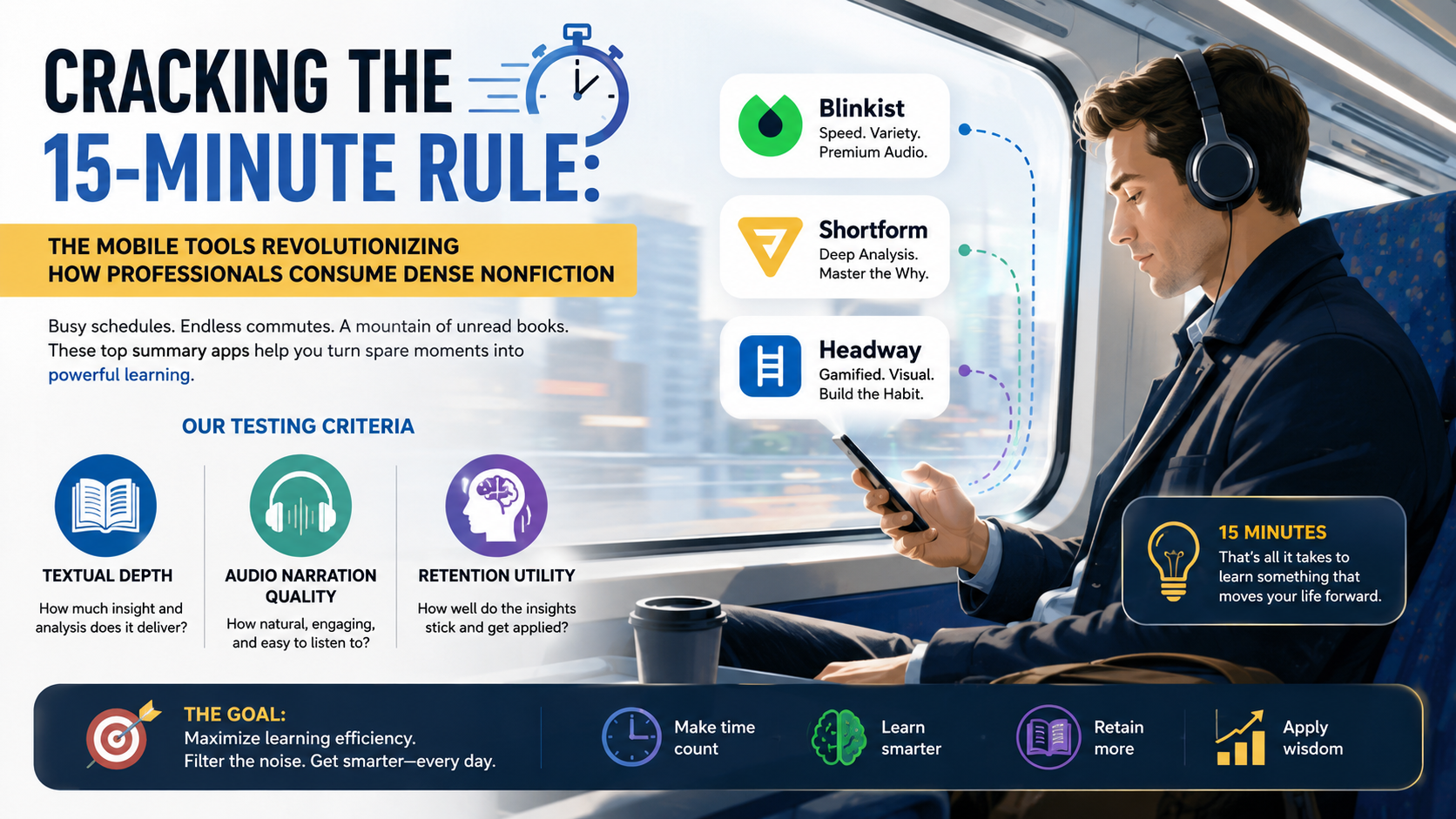
When leading summary apps are tested under real-world conditions—such as swapping social media doomscrolling for rapid-fire microlearning during morning train rides—it becomes clear that not all platforms are created equal. Some excel at delivering rapid, surface-level takeaways, while others pack an astonishing amount of analytical punch into a quarter of an hour. To filter out the noise and maximize learning efficiency, the most prominent platforms on the market were subjected to rigorous evaluation. Each was measured against three strict criteria: textual depth, audio narration quality, and actual retention utility.
Here is how the top three platforms fared in a hands-on analysis.
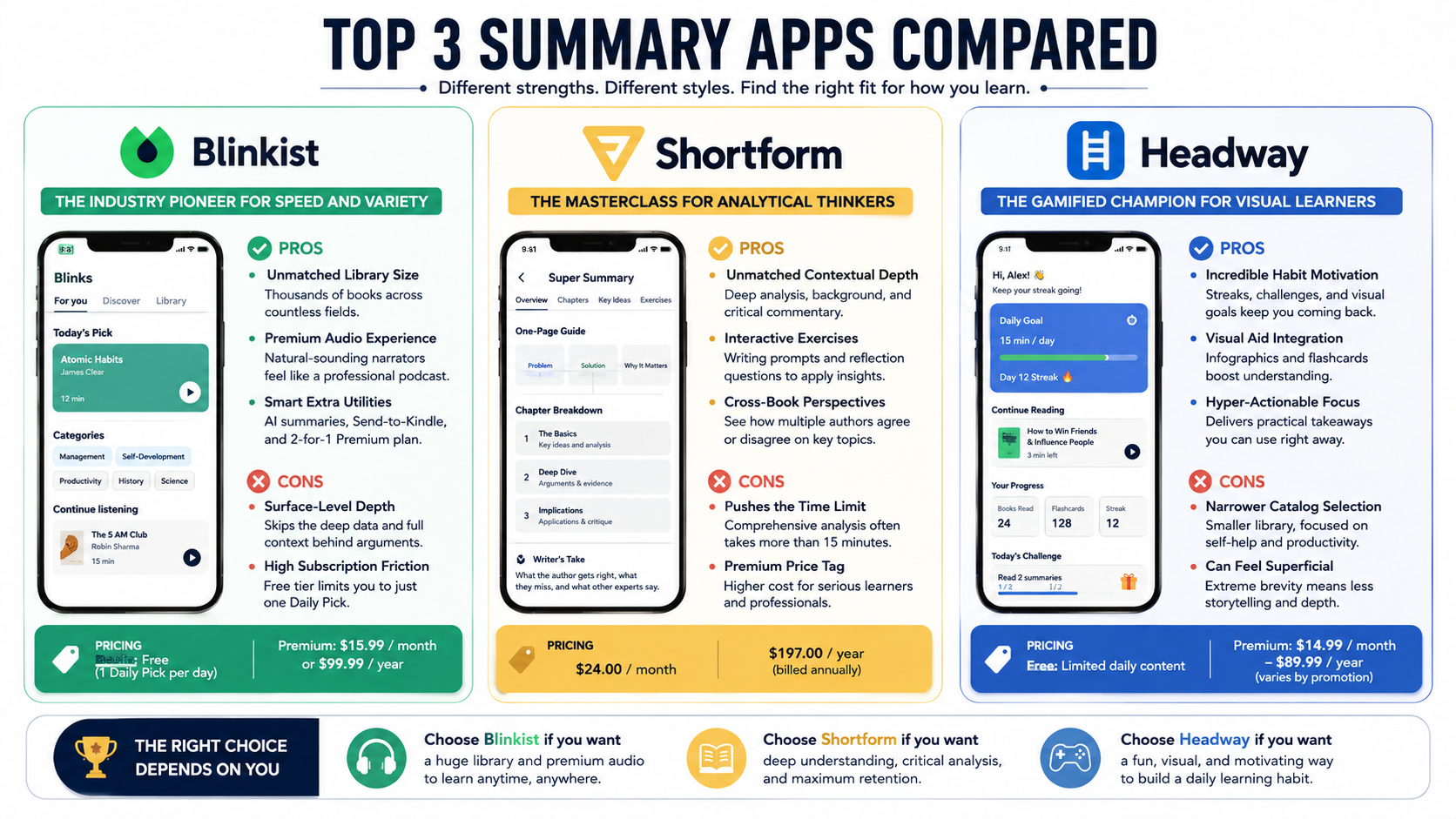
Blinkist is the undisputed titan of the microlearning space, and testing confirms its greatest strength is a massive, versatile catalog. Spanning over 8,000 titles, the app splits non-sensitive nonfiction topics into short, easily digestible text and audio segments called "Blinks." Listening to a summary of a productivity book during a short 15-minute break reveals a seamless experience. The audio delivery feels less like a synthetic voice and more like a professionally produced, highly engaging podcast. The app also features a built-in AI tool that allows users to upload external articles or PDFs to generate custom, rapid summaries on the fly.
Unmatched Library Size: Features thousands of books across fields like management, history, science, and personal growth.
Premium Audio Experience: Human-centric, natural-sounding narrators make listening on a noisy commute genuinely enjoyable.
Smart Extra Utilities: Offers a "2-for-1" Premium sharing plan and a seamless "Send-to-Kindle" feature for distraction-free reading.
Surface-Level Depth: It captures key insights beautifully, but frequently skips the comprehensive data backing up an author's claims.
High Subscription Friction: The free tier limits users to just one pre-selected "Daily Pick," making the premium tier practically mandatory for active learners.
Blinkist Basic: Free (restricted to 1 pre-selected summary per day).
Blinkist Premium: Around $15.99/month or $99.99/year (unlocks the full catalog and audio features).
If the goal is to truly master the underlying arguments of a dense book rather than just memorizing a few bullet points, Shortform completely changes the game. Analysis shows that Shortform doesn't just summarize—it actively analyzes. Instead of a basic list of takeaways, it structures its "super-summaries" into a powerful high-level one-page guide followed by deep, chapter-by-chapter breakdowns. What stands out during testing is the editorial commentary: the writers actively point out intellectual flaws in an author's logic and cross-reference concepts with competing books. It takes a bit more effort to finish a guide, but the retention level is significantly higher compared to competitors.
Unmatched Contextual Depth: Provides deep intellectual analysis and background information that standard summary apps skip entirely.
Interactive Exercises: Includes built-in writing prompts and reflection questions at the end of sections to force users to apply what they read.
Cross-Book Perspectives: Connects separate books together, showing how different authors agree or disagree on the same non-fiction topic.
Pushes the Time Limit: Because the analysis is so comprehensive, fully digesting a deep chapter breakdown can easily push past a casual 15-minute window.
Premium Price Tag: It is significantly more expensive than standard alternatives, targeting serious professionals and researchers.
Subscription-based: Around $24.00/month or $197.00/year (billed annually). Free access is limited to basic trial previews.
Headway approaches microlearning by treating nonfiction reading like a habit-building video game, reminiscent of popular language-learning platforms. Opening the app daily reveals vibrant progress bars, streak counters, and tailored challenges that immediately trigger a sense of accomplishment. The core feature that works beautifully here is its visual design. Summaries are accompanied by custom illustrations, text is broken into hyper-focused 3-minute chunks, and key takeaways can be converted into digital flashcards that leverage spaced repetition. For anyone who struggles to focus on dense blocks of text while sitting on a moving bus, Headway's bite-sized, punchy interface keeps eyes locked to the screen.
Incredible Habit Motivation: The streaks, daily achievements, and visual goals make it genuinely fun to log in every day.
Visual Aid Integration: Infographic-style summaries and interactive flashcards make complex concepts highly memorable.
Hyper-Actionable Focus: Skips long narratives to deliver immediate, practical real-world applications.
Narrower Catalog Selection: The library is noticeably smaller than Blinkist's and skews heavily toward self-help, wealth, and basic productivity.
Can Feel Superficial: The intense focus on brevity means users lose almost all of the author's original storytelling and flavor.
Freemium with Subscription: Free basic tier with limited daily content; Premium access requires a subscription typically ranging from $14.99/month to roughly $89.99/year depending on active promotional cycles.
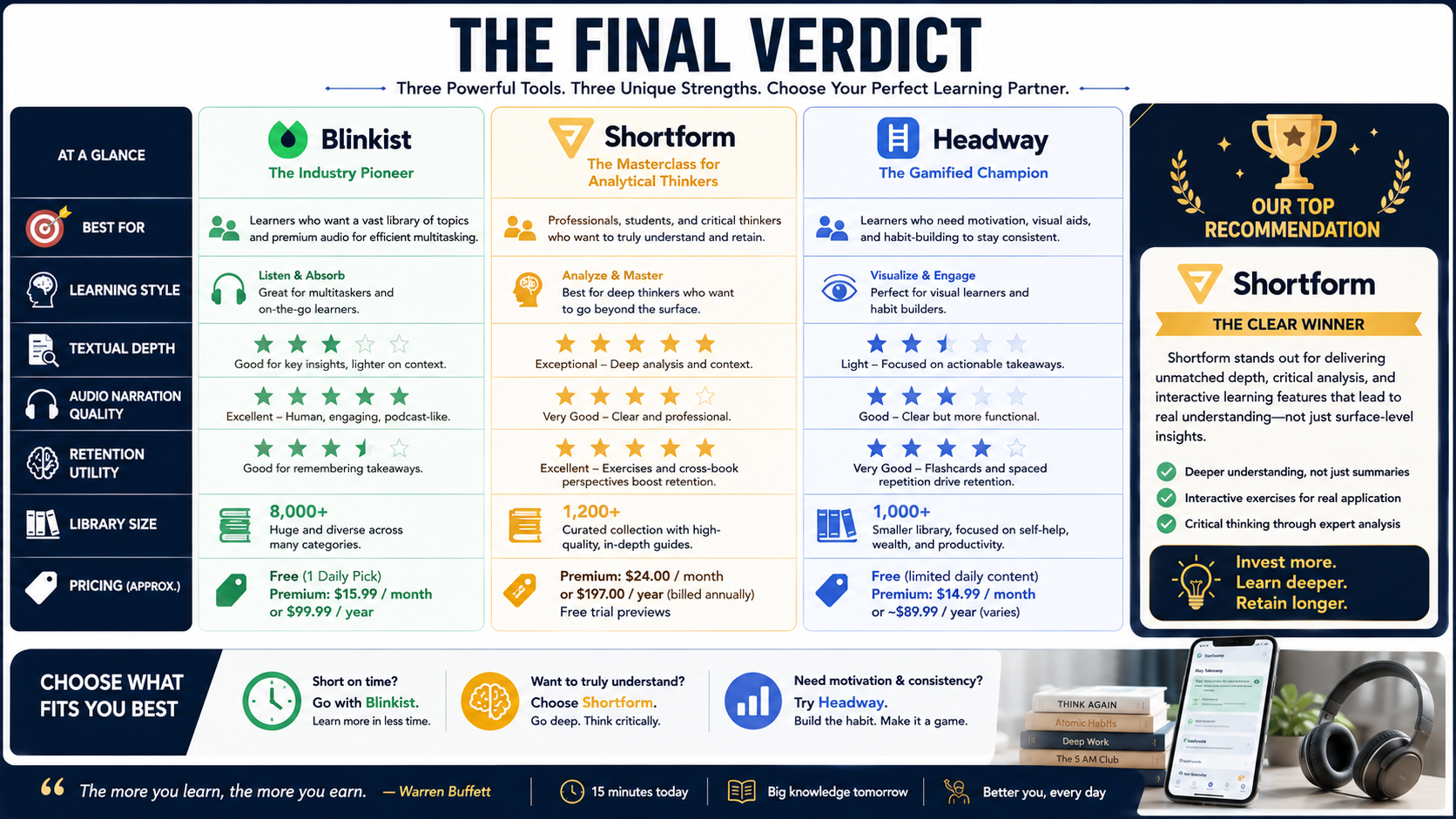
After weeks of evaluating these platforms during real-world gaps in a daily schedule, the right choice ultimately comes down to an individual's personal learning style.
If a reader wants a vast, sprawling library of diverse topics with top-tier audio narrations to listen to while multitasking, Blinkist remains the gold standard for pure efficiency. If a user struggles with reading consistency and needs psychological nudges, visual flashcards, and gamified mechanics to keep on track, Headway is the perfect companion to jumpstart a daily learning habit.
However, for professionals, students, and critical thinkers looking to extract the absolute maximum value from non-fiction books, Shortform is the definitive top recommendation. While it demands a higher financial investment, it completely solves the core flaw of the microlearning movement by refusing to sacrifice intellectual rigor for brevity. Its unique combination of structural chapter breakdowns, interactive exercises, and objective editorial critiques ensures that readers don't just skim the surface of a book—they truly understand it.