When we decided to overhaul our language-learning routines this year, we made a commitment to move past the superficial gamification that has dominated the app store for a decade. The realization came to us while standing in a busy Parisian bakery: despite maintaining a 300-day streak of matching vocabulary cards on a phone screen, we still couldn't confidently ask the baker to slice a loaf of sourdough.
Building actual, functional fluency requires shifting away from digital dopamine hits and toward tools engineered for cognitive retention, structural comprehension, and real-world conversation. Over the past four months, we put the leading platforms through rigorous, real-world field tests—using them while commuting, ordering food, and attempting to follow fast-paced foreign media.
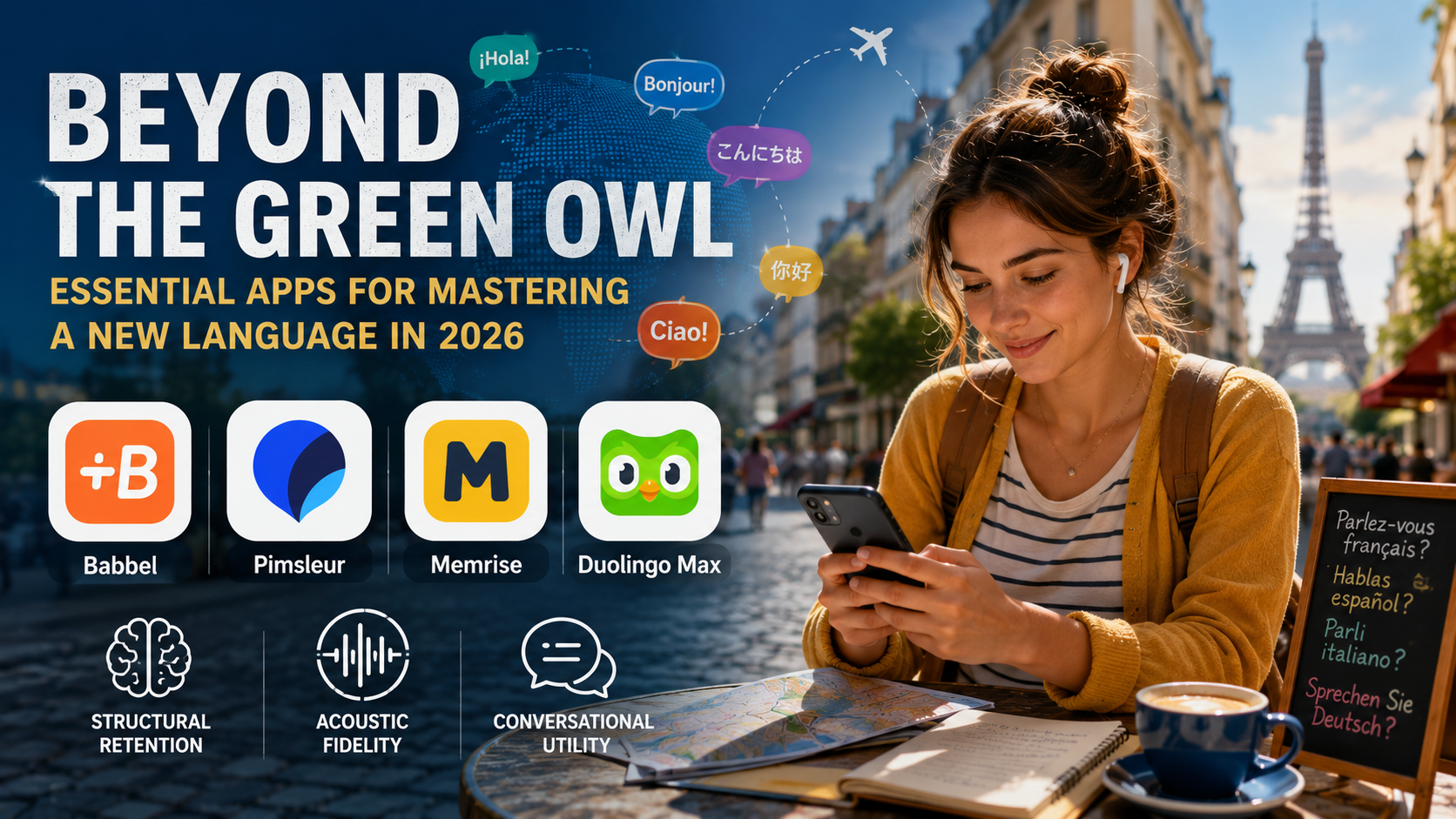
Our testing criteria focused on three strict pillars:
Structural Retention: Does the app teach how a language functions, or just how to memorize phrases?
Acoustic Fidelity: Are users listening to synthetic text-to-speech engines or authentic, native audio?
Conversational Utility: Does the practice translate to real-world communication confidence?
The following four applications stood out from the crowd, each addressing a distinct phase of the language-acquisition journey.
Availability: iOS, Android, Web
If you need to learn why a sentence is structured a certain way rather than just guessing the pattern, Babbel remains the gold standard for structural comprehension. When we tested Babbel's intermediate modules, the standout feature was its contextual grammar integration. Instead of forcing users to memorize dry conjugation tables, the app introduces a rule—such as the difference between por and para in Spanish—and immediately embeds it into a dialogue simulating a real-world scenario, like booking a hotel room.
The lessons are meticulously designed by a team of linguists rather than algorithms. Each 15-minute session acts as a self-contained unit that fuses vocabulary, grammar explanations, and cultural nuances. Babbel explains the mechanics of the language in plain English right at the moment of friction, preventing the frustration of making the same mechanical error repeatedly.
Pros: Deep, clear grammar explanations that remove the guesswork from learning; highly practical vocabulary geared toward real-world adult conversations; speech-recognition engine focuses heavily on realistic conversational pacing.
Cons: The interface feels distinctly businesslike and lacks visual excitement; lesson structures can feel repetitive if you try to complete more than three in a single sitting; advanced content is limited for less common languages.
Pricing Structure: Subscription-based. Rates run approximately $17.95 for a standalone month, scaling down to $8.95 per month when billed annually ($107.40). A Lifetime Subscription covering all 14 languages is available for a one-time payment of $299.99.
Availability: iOS, Android, Apple CarPlay, Android Auto
Pimsleur operates on an entirely different premise than its competitors: it eliminates the screen. Built around the principles of Dr. Paul Pimsleur's graduated interval recall, this audio-only system forces you to listen to a brief exchange between native speakers and actively participate by translating and repeating phrases on command.
We tested Pimsleur primarily during our daily morning commutes using the app's dedicated driving mode. The core mechanism is incredibly demanding but highly effective. The app asks, "How do you say: 'No, I want to buy something else'?" and gives you exactly three seconds to speak the answer aloud before a native speaker provides the correct pronunciation. Because you cannot rely on visual text cues, your brain is forced to rapidly map the acoustic sounds and retrieve the correct vocabulary from memory. For developing an authentic accent and sharp listening comprehension, this method is unmatched.
Pros: Exceptional for hands-free learning during commutes or workouts; forces immediate oral production, which builds authentic pronunciation and reduces speaking anxiety; audio features real native speakers utilizing natural cadence.
Cons: Virtually zero reading or writing instruction, requiring a secondary app to learn text systems; the formal, diplomatic tone of the vocabulary can occasionally feel a bit stiff for casual, modern settings; requires deep, uninterrupted mental focus.
Pricing Structure: Subscription-based. The standard Audio-Only plan is $14.95 per month, while the Premium tier (which adds supplementary visual flashcards and matching games) costs $19.95 per month.
Availability: iOS, Android, Web
Memrise is the ultimate digital vocabulary engine, specifically built to bridge the gap between textbook vocabulary and the actual slang spoken on the street. The absolute killer feature here is the "Learn with Locals" video integration. Instead of listening to a robotic voice file, the app presents thousands of short vertical video clips of actual native speakers in their home cities shouting, whispering, or casually dropping idioms.
When we used Memrise to brush up on conversational phrases, the value of seeing facial expressions, mouth movements, and varying regional accents became immediately clear. The app utilizes a highly optimized spaced-repetition system (SRS) that tracks how well you retain words, automatically resurfacing difficult terms right before your brain is about to forget them. It doesn’t teach deep grammar, but for sheer vocabulary acquisition and idiom tracking, it is an elite tool.
Pros: Video clips expose users to authentic dialects, varied speech speeds, and natural body language; the spaced-repetition algorithm makes short-term vocabulary retention highly efficient; user-generated decks provide specialized vocabulary for niche topics.
Cons: Grammatical explanations are thin to non-existent; exercises are heavily reliant on multiple-choice recognition rather than independent sentence creation; the constant push to upgrade can degrade the free user experience.
Pricing Structure: Freemium. The basic tier allows access to introductory course blocks. Memrise Pro costs $24.99 for a flexible single month, $61.99 for an annual pass, or $329.99 (frequently discounted to $99.00) for a Lifetime license.
We included Duolingo's highest tier, Duolingo Max, because it addresses a massive historic flaw in the platform: the lack of advanced conversational practice. Powered by specialized generative AI integrations, Duolingo Max introduces two transformative features: "Roleplay" and "Video Call."
During our testing sessions, we engaged in simulated text and audio conversations with the app's established characters, like Lily or Oscar. Instead of checking a fixed box, the AI adapts to whatever you write or say, allowing you to practice ordering a coffee, planning a trip, or discussing a hobby in a sandbox environment. When you make a subtle mistake, the system provides an inline breakdown explaining exactly why your phrasing felt unnatural to a native ear. While the core app remains a gamified vocabulary puzzle, this premium tier pushes the experience into genuine conversational territory.
Pros: Highly interactive AI roleplaying adapts directly to creative user inputs; immediate, personalized explanations of nuanced grammatical errors; the classic gamified structure remains highly effective for building a daily habit loop.
Cons: The individual AI exchanges can feel slightly brief and scripted before redirecting you; it does not offer full pronunciation scoring during continuous dialogue; the price point is a major step up from standard app subscriptions.
Pricing Structure: Freemium model with premium tiers. While basic Duolingo is free with ads and heart limits, Duolingo Max sits at the top of the pricing structure at $29.99 per month or $168.00 when billed annually.

Choosing the absolute best language application comes down to identifying your immediate operational bottleneck.
If your primary hurdle is conversational anxiety—meaning you freeze when someone speaks to you in a foreign language—Pimsleur is the definitive choice. Its audio-only, high-pressure recall framework forces your brain to build the immediate acoustic muscle memory required to listen and respond without relying on a digital screen. It strips away the training wheels of mobile apps and forces you to actually speak from day one.
For learners seeking a comprehensive, well-rounded foundational approach that balances reading, writing, and grammatical comprehension without hitting a wall of confusion, Babbel wins the overall category. Its logical, expert-crafted curriculum ensures you understand the underlying machinery of your target language, giving you the tools to build your own complex sentences rather than just repeating memorized patterns.