Tackling high-level medical or legal terminology is like trying to learn a dead language over a weekend. Whether students are facing the staggering vocabulary required for anatomy exams or the dense Latin phrasing needed to navigate constitutional law case briefs, traditional brute-force memorization simply falls apart at scale. Staring at a list of 5,000 terms is not just inefficient; it leads to massive cognitive burnout. (Disclaimer: The apps discussed here are strictly for educational and vocabulary memorization purposes and do not constitute professional legal or medical advice.)
The pain point is universal: how do learners retain highly technical, specialized vocabulary over months or years without forgetting the basics? The answer lies in spaced-repetition software (SRS). This technology spaces out review intervals based on how well a user remembers a specific card, forcing the brain to recall information right at the edge of forgetting.
To separate the genuinely powerful tools from basic digital index cards, we put the current market leaders through a rigorous evaluation. When we tested these apps on the road, we didn't just look at their color schemes. We loaded them with massive decks of pharmacology terms and complex legal doctrines to evaluate their underlying scheduling algorithms, cross-platform syncing reliability, and true cost of ownership. Based on our hands-on experience, here are the three spaced-repetition platforms that actually deliver results for advanced terminology.
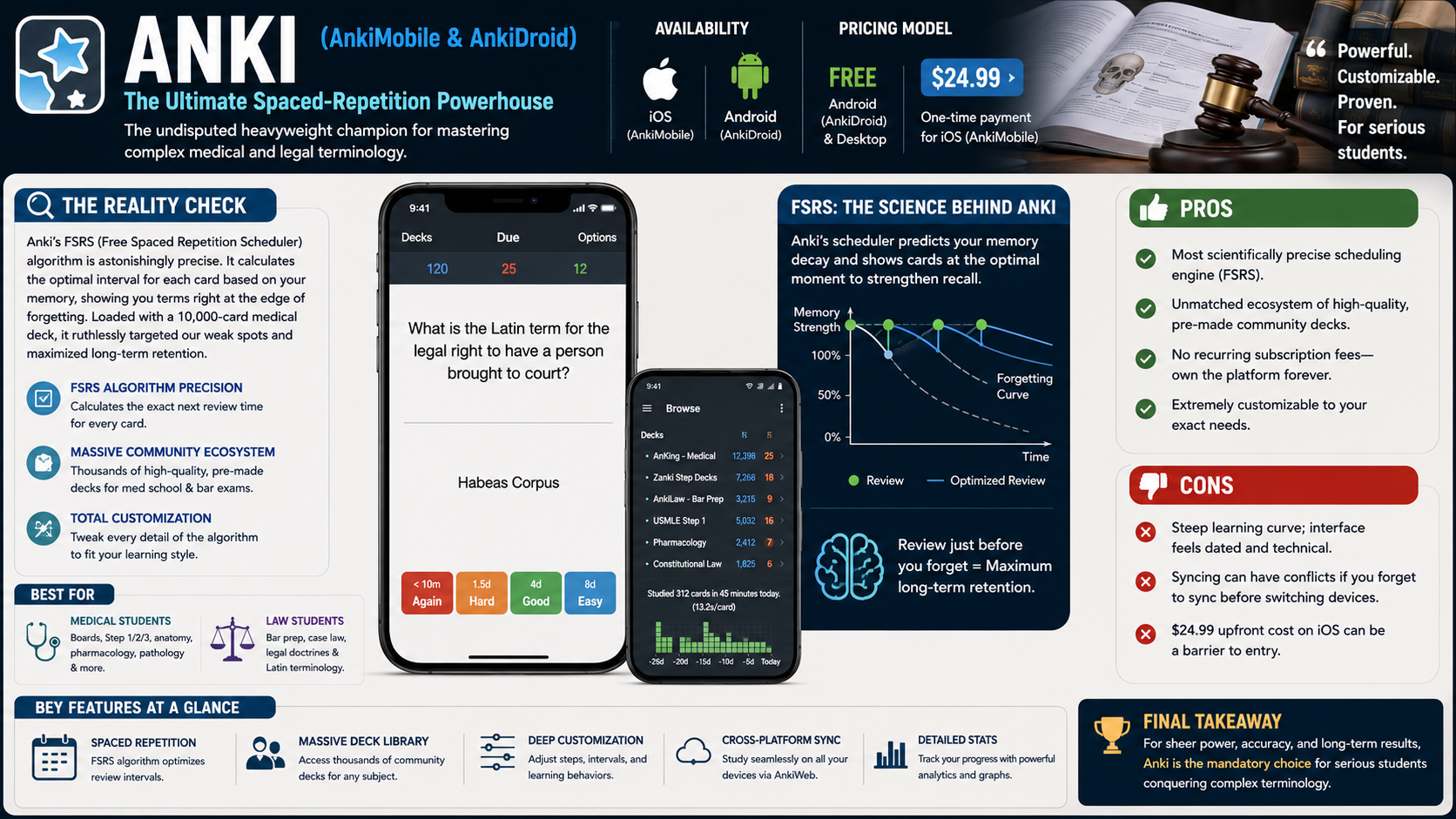
Availability: iOS (AnkiMobile) and Android (AnkiDroid)
Pricing Model: Free on Android (AnkiDroid) and Desktop; $24.99 one-time paid app for iOS (AnkiMobile).
For years, Anki has been the undisputed heavyweight champion in medical schools, and its adoption among law students is rapidly increasing. It is an open-source powerhouse that relies on a fiercely dedicated community rather than a flashy corporate marketing team.
The core feature that actually works is Anki's completely overhauled FSRS (Free Spaced Repetition Scheduler) algorithm. When we loaded a notoriously brutal, 10,000-card community medical deck into the app, the algorithm's precision in isolating our weak spots was startling. Unlike basic apps that just shuffle cards randomly, Anki calculated exactly how many days, hours, or minutes to wait before showing us "habeas corpus" or "myocardial infarction" again. The customization is nearly absolute. Users can tweak the precise mathematical weight of their learning steps, making it the most powerful engine available for forcing massive amounts of vocabulary into long-term memory.
Pros:
The underlying algorithm is the most scientifically precise scheduling engine currently available.
An unmatched ecosystem of massive, pre-made community decks specifically tailored for medical boards and bar exams.
No recurring subscription fees; once the iOS app is purchased (or downloaded for free on Android), users own the platform forever.
Cons:
The learning curve is notoriously brutal; the interface feels like database software from 2010.
Syncing across devices requires creating an AnkiWeb account, which can occasionally encounter conflict errors if users forget to sync manually before switching devices.
The $24.99 upfront cost for iOS users is a steep barrier to entry, even if it saves money long-term compared to subscription models.
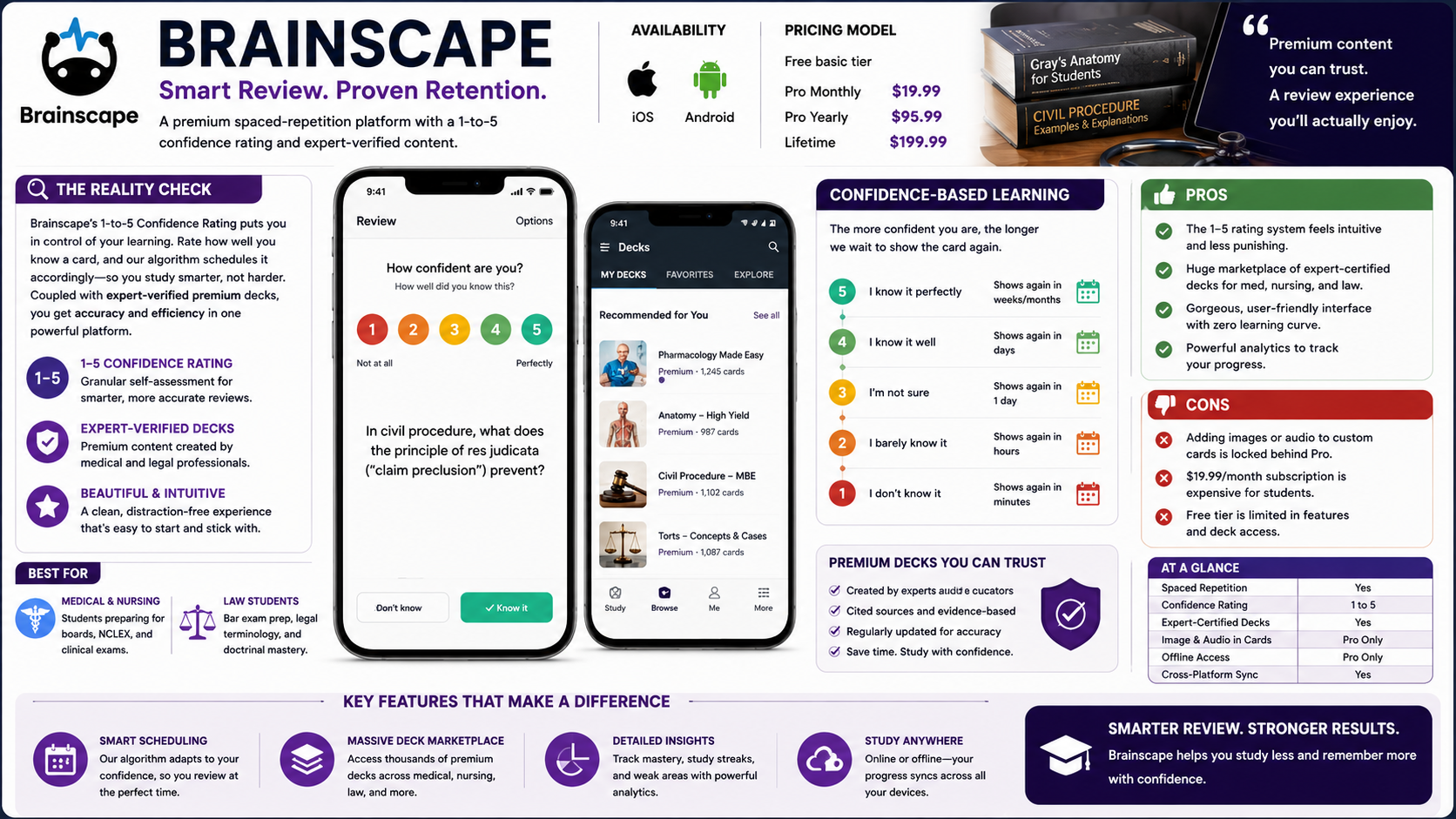
Pricing Model: Free basic tier; Pro subscription costs $19.99/month, $95.99/year, or a $199.99 one-time lifetime payment.
If Anki is a manual-transmission sports car that requires a mechanic to tune, Brainscape is a luxury automatic. It focuses entirely on delivering a frictionless, highly polished user experience tailored for serious academic and professional learners.
The feature that truly elevates Brainscape is its 1-to-5 Confidence Rating system combined with its curated, expert-verified premium decks. When we tested the app on a grueling set of civil procedure terminology, we weren't forced into a binary "Right/Wrong" choice. Instead, rating a card a "2" (meaning we barely recognized the term) brought it back almost immediately, while a "5" pushed it deep into the future. Furthermore, Brainscape partners with real medical and legal educators to create their certified premium content. We didn't have to worry about whether a user-generated deck had incorrect definitions for complex tort law; the premium marketplace offered vetted accuracy, saving dozens of hours of fact-checking.
Pros:
The granular 1-5 self-assessment rating feels far more intuitive and less punishing than standard SRS interfaces.
A massive marketplace of expert-certified, pre-vetted decks specifically designed for medical, nursing, and law students.
A gorgeous, distraction-free interface that requires absolutely no technical setup or coding knowledge to use immediately.
Cons:
Adding images or audio to custom flashcards—a critical feature for anatomy terminology—is locked behind the Pro paywall.
The subscription pricing ($19.99/month) is steep for students already burdened with tuition costs.
Pricing Model: Free tier available; Pro subscription is $14.99/month ($149.99/year), and Pro with AI is $29.99/month ($299.99/year).
RemNote takes a fundamentally different approach to spaced repetition. Instead of building flashcards as a separate task, RemNote integrates the flashcard creation directly into the note-taking process, making it an all-in-one knowledge management system.
The core feature that makes RemNote indispensable is its PDF Annotation and Image Occlusion pipeline. Legal and medical terminology rarely exists in a vacuum; it is deeply tied to broader case briefs or physiological systems. When we pasted a dense medical text regarding the central nervous system into RemNote, the platform allowed us to highlight terms and instantly turn them into flashcards without leaving the document. When we uploaded a complex anatomy diagram, the image occlusion tool let us draw boxes over specific labels. The app then automatically generated a deck that tested us on those hidden labels. For students who need to synthesize lecture notes, textbook PDFs, and flashcards in one unified workspace, RemNote eliminates the friction of jumping between multiple apps.
Pros:
Seamlessly transforms typed lecture notes and PDF highlights directly into spaced-repetition flashcards in real-time.
Flawless execution of image occlusion cards, which is an absolute necessity for mastering visual medical terminology and anatomy.
The free tier is surprisingly robust, offering unlimited notes, flashcards, and synced devices.
Cons:
The interface can feel cluttered and overwhelming for users who just want a simple, standalone flashcard app.
The advanced AI features—which can automatically generate flashcards from dense text—require a very expensive $29.99/month subscription.
When it comes to mastering the sheer volume and complexity of high-level medical and legal terminology, Anki (AnkiMobile/AnkiDroid) remains the absolute best app on the market.
While Brainscape offers a more polished interface and RemNote provides incredible note-taking integration, Anki's proprietary spaced-repetition algorithm is scientifically unmatched for brute-forcing thousands of terms into long-term memory. Furthermore, the massive ecosystem of free, highly accurate community decks tailored specifically for medical boards and legal exams means users do not have to build their study materials from scratch. Despite its dated interface and the initial $24.99 cost for iOS users, Anki's lack of recurring subscription fees and unparalleled customizability make it the mandatory choice for serious students facing career-defining exams.